Democratic Party Theyre Going to List Again
71% of Republican voters say their vote for Congress is 'against Biden'
Pew Inquiry Center conducted this study to empathize how the public views control of Congress, issues for the upcoming midterm elections and confidence in how the elections volition exist conducted. For this analysis, we surveyed 10,441 U.S. adults in March 2022. Everyone who took role in this survey is a member of the Eye's American Trends Panel (ATP), an online survey panel that is recruited through national, random sampling of residential addresses. This style almost all U.S. adults have a take chances of option. The survey is weighted to be representative of the U.S. adult population by gender, race, ethnicity, partisan amalgamation, educational activity and other categories. Read more virtually the ATP's methodology.
Here are the questions used for the study, along with responses, and its methodology.
With the midterm congressional elections even so more than 7 months away, registered voters are evenly divided between the two major parties in their election preferences. At the same fourth dimension, Republican voters are more likely than Democratic voters to say it "really matters" which party gains command of Congress in this fall's midterms.
At this early on stage of the campaign, President Joe Biden is much more of a motivating gene for Republican than Democratic voters: 71% of Republican and Republican-leaning voters say they recall of their vote as being "against" Biden; far fewer Democrats and Democratic-leaning voters (46%) view their vote as a vote "for" the president.
The new Pew Research Center survey of ten,441 U.S. adults, including nine,021 registered voters, conducted March seven-xiii, 2022, finds that most voters (63%) say which party wins control of Congress in this twelvemonth's elections "really matters," similar to the share who said this in early 2018 (65%).
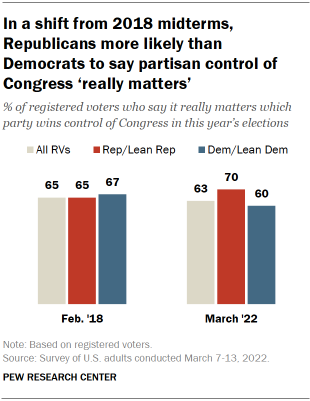
Today, in contrast with 2018, Republican registered voters (70%) are more likely than Autonomous voters (60%) to say which party wins control of Congress this year really matters. Iv years agone, there were simply slight partisan differences on this measure (67% of Democrats and 65% of Republicans said information technology really mattered which party controlled Congress following the elections) and that remained the instance throughout the 2018 entrada.
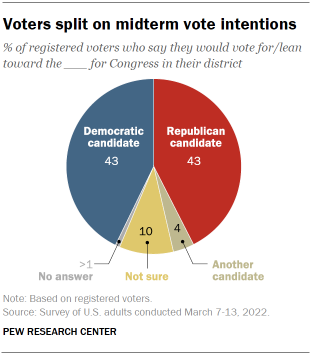
The new survey finds that equal shares of registered voters say, if the elections were held today, they would support the Republican candidate or the Democratic candidate (43% each) in their commune. Another 10% say they are not sure who they would support, while 4% would vote for other candidates.
Early in the 2018 midterm cycle, Democratic candidates had a double-digit edge over Republicans on the generic congressional ballot. Democrats went on to gain the bulk in the U.S. Firm of Representatives that year.
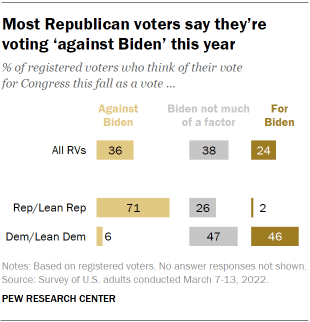
As in previous midterms, voters are more probable to view their vote as an expression of opposition than support for the president. That is the instance today: 36% say their midterm vote is against Biden, while 24% think of it as a vote for Biden; 38% say Biden is not much of a factor in their voting decision.
The partisan disparity in these views is wide: Nearly three times as many Republican voters call up of their vote equally being against Biden as say the president is non much of a factor in their vote (71% vs. 26%); by dissimilarity, Democratic voters are about every bit likely to say Biden is not much of a gene (47%) equally to say their midterm vote volition be "for" him (46%).
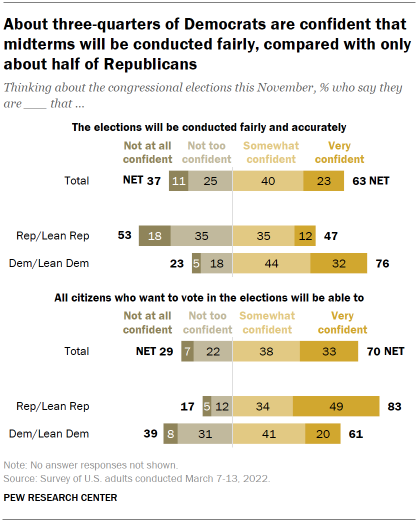
Amid the continuing conflicts over the 2020 ballot, a bulk of Americans say they are very (23%) or somewhat confident (twoscore%) that the midterm elections will be conducted fairly and accurately. However, there are sizable partisan differences in conviction: While 76% of Democrats say they are confident the autumn elections volition be conducted fairly and accurately (32% are very confident), only about one-half of Republicans (47%) say the same (12% say they are very confident).
7-in-ten adults are also very or somewhat confident that all citizens who want to vote in the congressional elections will be able to do so. In that location are partisan differences in these views as well: Democrats are most 20 percent points less likely than Republicans to express conviction that all citizens who want to vote will be able to exercise so (61% of Democrats vs. 83% of Republicans).
Top election issues for Republicans and Democrats
Nigh 8-in-10 voters (78%) say the economy is very important to their vote this autumn, making information technology the acme upshot out of xv asked about in the survey. Republicans are peculiarly likely to say the economy is very important to their vote in the autumn: 90% say this, compared with 68% of Democrats.
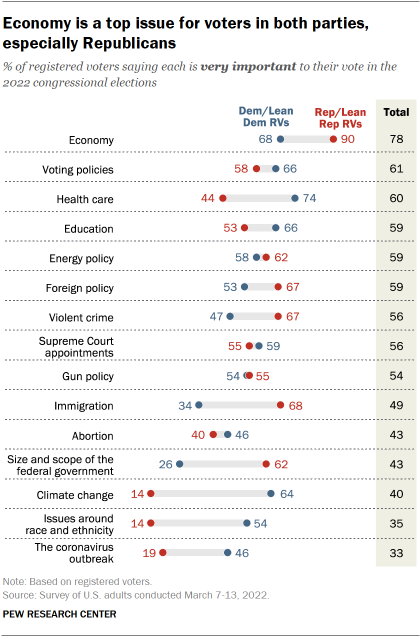
Roughly two-thirds of Republican voters say that immigration (68%), foreign policy (67%) and violent criminal offence (67%) are very important to their vote, while well-nigh as many (62%) say this about the size and scope of government. Autonomous voters are less probable than Republicans to say each of these is very important, though the gap is peculiarly pronounced on the issues of immigration (just 34% of Democrats say immigration is very important to their vote in the autumn) and the size and scope of government (just 26% of Democrats say this is very of import to their vote).
By comparison, health care is the summit issue for Democratic voters in the autumn, with 74% saying it is very important to their vote; just 44% of Republican voters say the aforementioned.
Most ii-thirds of Democratic voters signal to voting policies (66%) and education (also 66%) every bit very important to their vote, modestly college than the shares of GOP voters naming these issues equally very of import to their vote.
Just the partisan gap over climate change is one of the largest in the survey: Democratic voters are l percentage points more probable than Republican voters to name information technology as an important issue in their vote (64% vs. xiv%) and are 40 points more likely to say the same about issues around race and ethnicity (54% vs. 14%).
Just a third of voters say that the coronavirus outbreak will be a very important issue in their vote this fall, though Democrats are more than twice as likely every bit Republicans to say this (46% vs. 19%).
Congressional vote preferences
Overall, voters are carve up on who they would vote for if the elections were held today: 43% say they would vote for the Republican candidate in their district, while an identical share say they would vote for the Democratic candidate; 4% say they would vote for another candidate and ten% say they are not sure.
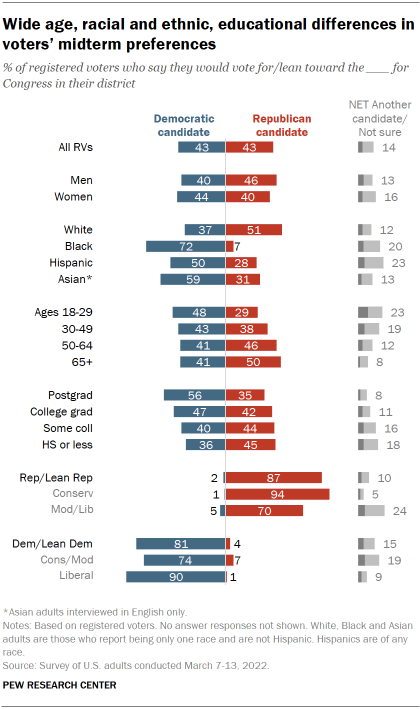
There are wide differences in vote preference based on race and ethnicity, age and teaching.
About half of White voters (51%) say they would vote for the Republican candidate, while 37% would vote Democratic. By contrast, a large majority of Black voters (72%) say they would prefer the Democratic candidate, while 7% prefer the Republican candidate. Asian voters favor Democratic over Republican candidates by about two-to-one (59% vs. 31%); Hispanic voters also favor Democrats (50%) over Republicans (28%).
Equally in recent elections, older voters remain more supportive of Republican candidates than Democrats: Half of voters ages 65 and older say they would vote for a Republican if the elections were held today, while 41% say they would vote for a Democrat. Past dissimilarity, about half of voters under 30 say they would vote for a Autonomous candidate if the elections were held today, while 29% say they would back the GOP candidate. Voters nether 30 likewise are nearly twice as likely equally voters 65 and older to be unsure about who they would vote for (xiii% vs. 7%).
Voters with college degrees, especially those with postgraduate degrees, are more supportive of Democrats than Republicans this fall, while Republicans hold an advantage among voters with some college or less pedagogy.
Source: https://www.pewresearch.org/politics/2022/03/24/republicans-more-likely-than-democrats-to-say-partisan-control-of-congress-really-matters/
0 Response to "Democratic Party Theyre Going to List Again"
Post a Comment