Is Tracing Paper the Same as Translucent Deli Paper for Art

A roll of yellow tracing paper.

Simulation of tracing paper transformation levels


Tracing paper is newspaper fabricated to have low opacity, allowing light to pass through. It was originally developed for architects and design engineers to create drawings that could be copied precisely using the diazo copy process;[ citation needed ] it so establish many other uses. The original use for drawing and tracing was largely superseded by technologies that do non require diazo copying or manual copying (by tracing) of drawings.
The transparency of tracing newspaper is achieved by careful selection of the raw materials and the process used to create transparency. Cellulose fibre forms the basis of the paper, unremarkably from wood species but also from cotton fibre. Often, paper contains other filler materials to heighten opacity and impress quality. For tracing or translucent paper, it is necessary to remove any material which obstructs the transmission of light.[1]
Description [edit]
Tracing paper is paper made to have low opacity, assuasive light to pass through. It is named as such for its ability for an epitome to be traced onto it. It was originally developed for architects and design engineers to create drawings which could be copied precisely using the diazo re-create process.[ citation needed ]
When tracing paper is placed onto a moving picture, the picture is easily visible through the paper. Thus, it becomes easy to detect edges in the picture and trace the image onto the tracing newspaper. Pure cellulose cobweb is translucent, and it is the air trapped between fibers that makes newspaper opaque and look white.[one] If the fibers are refined and beaten until all the air is taken out, then the resulting sheet will exist translucent. Translucent papers are dense and contain upwards to ten% moisture at fifty% humidity.
Production [edit]
Tracing paper is usually fabricated from sulfite lurid by reducing the fibres to a land of fine subdivision and hydrolysing them by very prolonged chirapsia in water.
There are three primary processes to industry this blazon of newspaper, as follows:
- Through mechanical 'refining' of the cellulose fibre to create a fibre which is highly fibrillated and gelatinous, and then that in forming the sheet of newspaper, most all air is excluded from the internal construction of the paper. This method produces a very translucent and fifty-fifty looking paper over a range of areal densities from 42 to over 280 thousand/gii.
- Past making a 'normal' sheet of newspaper and then filling the spaces betwixt the fibres with a material that has the aforementioned refractive index as the cellulose. This was a common procedure adopted in the United states. The product was frequently called Vellum, although this terminology tin can refer to a wider range of special papers. Due to the relatively high cost, this method of manufacture has largely disappeared.
- As with 2, by making a normal sheet of newspaper, which is followed by immersing uncut and unloaded newspaper of adept quality in sulfuric acid for a few seconds. The acid converts some of the cellulose into amyloid form having a gelatinous and impermeable character. When the treated paper is thoroughly washed and dried, the resultant product is much stronger than the original paper. Tracing paper is resistant to oil, grease and to a large extent impervious to water and gas.
The sizing in production will determine whether it is for laser printer or inkjet/offset printing.
Tracing paper may exist uncoated or coated.[ further explanation needed ] Natural tracing paper for laser printing is usually uncoated.
The HS lawmaking for tracing paper is 4806.xxx.[2]
Tracing paper tin be recycled and also can be made from upwards to 30% recycled fibre.[three]
Technical specifications [edit]
- Specifications of natural tracing paper:
- Polish surface
- Not-ageing
- Acid-free
- Recyclable
The follows are mutual standards for tracing paper[ citation needed ] though more often than not it is manufactured in densities over sixty 1000/mtwo:
| Substance | Density | Humidity | Roughness | Translucent | Tensile strength (mD) | Surface alkali pH |
|---|---|---|---|---|---|---|
| ISO 536 [4] (chiliad/mii) | (kg/yardthree) | ISO 287 [5] (%) | ISO 8791-2[6] (ml/min) | ISO 2469[seven] (%) | ISO 1974[8] (mN) | ISO 6588 [9] [10] (pH) |
| 42 | 1,200÷ane,235 | 7 | 100-300 | 79+/-five | 220-440 | six-7 |
| 53 | 1,200÷1,235 | vii | 100-300 | 77+/-five | 220-440 | half dozen-seven |
| 63 | ane,220÷i,250 | 7 | 100-300 | 75+/-5 | 220-440 | 6-vii |
| 73 | i,220÷1,250 | seven.5 | 100-300 | 75+/-v | 220-440 | half-dozen-7 |
| 83 | ane,220÷1,250 | 7.5 | 100-300 | 75+/-v | 220-440 | half-dozen-7 |
| 93 | 1,220÷i,250 | vii.5 | 100-300 | 75+/-v | 220-440 | 6-vii |
| 100 | 1,220÷ane,250 | 7.5 | 100-300 | 75+/-five | 220-440 | 6-vii |
| 112 | 1,220÷1,250 | viii | 100-300 | 73+/-5 | 220-440 | 6-7 |
| 130 | 1,220÷i,250 | viii | 100-300 | 69+/-v | 220-440 | half dozen-vii |
| 150 | 1,220÷one,250 | eight | 100-300 | 65+/-5 | 220-440 | vi-vii |
| 160 | 1,220÷i,250 | 8 | 100-300 | 61+/-v | 220-440 | 6-seven |
| 170 | 1,220÷1,250 | 8 | 100-300 | 59+/-5 | 220-440 | 6-7 |
| 190 | i,220÷i,250 | 8 | 100-300 | 55+/-5 | 220-440 | half dozen-7 |
| 200 | ane,220÷1,250 | eight | 100-300 | 53+/-v | 220-440 | 6-7 |
| 240 | 1,220÷1,250 | eight | 100-300 | 47+/-5 | 220-440 | vi-7 |
| 280 | 1,220÷1,250 | 8 | 100-300 | 45+/-five | 220-440 | vi-seven |
Awarding [edit]
- Traditional printing methods: letterpress, planographic / start, silk-screen printing
- Light amplification by stimulated emission of radiation and inkjet printing
- Processing: varnishing, laminating, punching, embossing, folding, scoring[ citation needed ]
- Cartoon: ink, Indian ink, graphite, pencils
- Photographic and cinema lighting: diffusion filter for lite sources to produce aesthetic effect
End products [edit]
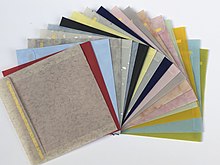
Invitation square envelopes
- Envelopes
- Mailings
- Flyer
- Coversheets
- Album encompass dividers
- Business organization cards
- Greeting cards
- Posters
- Origami
See also [edit]
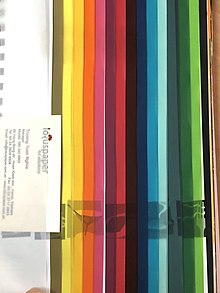
Schoellershammer multy color tracing paper
- Inkjet paper
- Color tracing newspaper: Tracing paper also can be solid or marble coloured. In modernistic times, colour tracing paper is ordinarily used for decoratively for special printing purposes such as for brochures, menus, and invitations
- Parchment paper
- Wax paper
- Glassine paper
- Red rosin paper
References [edit]
- ^ a b How is paper fabricated translucent (grease proof, tracing newspaper)? PaperOnWeb
- ^ "Newspaper and paperboard; articles of newspaper pulp, of newspaper or of paperboard". wcoomd.org.
- ^ "Frequently Asked Questions | Arjoqiggins Creative Papers". arjowiggins-tracingpapers.com.
- ^ "ISO 536:2012 – Paper and board -- Determination of grammage". iso.org.
- ^ "ISO 287:2009 – Newspaper and board -- Determination of moisture content of a lot -- Oven-drying method". iso.org.
- ^ "ISO 8791-2:2013 – Paper and board -- Determination of roughness/smoothness (air leak methods) -- Role 2: Bendtsen method". iso.org.
- ^ "ISO 2469:2014 – Paper, board and pulps -- Measurement of diffuse radiance gene (diffuse reflectance factor)". iso.org.
- ^ "ISO 1974:2012 – Paper -- Decision of trigger-happy resistance -- Elmendorf method". iso.org.
- ^ "ISO 6588-1:2012 – Newspaper, board and pulps -- Determination of pH of aqueous extracts -- Part one: Common cold extraction". iso.org.
- ^ ISO 6588-ii:2012 Paper, lath and pulps -- Determination of pH of aqueous extracts -- Part 2: Hot extraction
External links [edit]
- Arjowiggins tracing paper production description
- Properties of different types of paper
- Tracing paper in Vietnam annal
- Usage guide of tracing paper
Source: https://en.wikipedia.org/wiki/Tracing_paper
0 Response to "Is Tracing Paper the Same as Translucent Deli Paper for Art"
Post a Comment